
Graduate

Research and Product Dissemination and Sustainability: Approaches and Considerations

Many, if not most, DRK–12 projects grapple with challenges and opportunities related to dissemination and sustainability. Dissemination strategies to optimize the visibility of a project and reach of key research outputs may be part of a larger sustainability plan to support uptake of research products, models, and interventions and extend the impact of the project results.

Author/Presenter

CADRE

Year
2019
Short Description

This document features issues and approaches that were discussed by a “critical friends group” in the process of providing input to a DRK-12 project on dissemination strategies. While not comprehensive, the considerations listed may serve as a reminder of what to think through when you are conceptualizing and designing your next research and development project.

From Pilots to Products: Notes from a Gathering of Researchers and Developers at the 2018 DRK-12 PI Meeting

This document captures the ideas and experiences shared by DRK–12 awardees who attended a forum to explore different routes toward product sustainability. It includes notes on types of DRK-12 products, use and adoption of products, resources needed to support dissemination and sustainability of products, sources of support, and indicators of successful product dissemination and sustainability.

Author/Presenter

CADRE

Year
2019
Short Description

This document captures the ideas and experiences shared by DRK–12 awardees who attended a forum to explore different routes toward product sustainability. It includes notes on types of DRK-12 products, use and adoption of products, resources needed to support dissemination and sustainability of products, sources of support, and indicators of successful product dissemination and sustainability.

Principles for Designing Large-Format Refreshable Haptic Graphics Using Touchscreen Devices: An Evaluation of Nonvisual Panning Methods

Touchscreen devices, such as smartphones and tablets, represent a modern solution for providing graphical access to people with blindness and visual impairment (BVI). However, a significant problem with these solutions is their limited screen real estate, which necessitates panning or zooming operations for accessing large-format graphical materials such as maps.

Author/Presenter

Hari Prasath Palani

Nicholas A. Giudice

Lead Organization(s)
Year
2017
Short Description

This article describes the development of four novel non-visual panning methods designed from the onset with consideration of these perceptual and cognitive constraints.

Touchscreen-Based Haptic Information Access for Assisting Blind and Visually-Impaired Users: Perceptual Parameters and Design Guidelines

Touchscreen-based smart devices, such as smartphones and tablets, offer great promise for providing blind and visually-impaired (BVI) users with a means for accessing graphics non-visually. However, they also offer novel challenges as they were primarily developed for use as a visual interface. This paper studies key usability parameters governing accurate rendering of haptically-perceivable graphical materials.

Author/Presenter

Hari Prasath Palani

Jennifer L. Tennison

G. Bernard Giudice

Nicholas A. Giudice

Lead Organization(s)
Year
2018
Short Description

This paper studies key usability parameters governing accurate rendering of haptically-perceivable graphical materials

Touchscreen-Based Haptic Information Access for Assisting Blind and Visually-Impaired Users: Perceptual Parameters and Design Guidelines

Touchscreen-based smart devices, such as smartphones and tablets, offer great promise for providing blind and visually-impaired (BVI) users with a means for accessing graphics non-visually. However, they also offer novel challenges as they were primarily developed for use as a visual interface. This paper studies key usability parameters governing accurate rendering of haptically-perceivable graphical materials.

Author/Presenter

Hari Prasath Palani

Jennifer L. Tennison

G. Bernard Giudice

Nicholas A. Giudice

Lead Organization(s)
Year
2018
Short Description

This paper studies key usability parameters governing accurate rendering of haptically-perceivable graphical materials

Comparing Haptic Pattern Matching on Tablets and Phones: Large Screens Are Not Necessarily Better

Significance: Touchscreen-based, multimodal graphics represent an area of increasing research in digital access for individuals with blindness or visual impairments; yet, little empirical research on the effects of screen size on graphical exploration exists. This work probes if and whenmore screen area is necessary in supporting a patternmatching task.

Author/Presenter

Jennifer L. Tennison

Zachary S. Carril

Nicholas A. Giudice

Jenna L. Gorlewicz

Year
2018
Short Description

The current study investigates two questions: (1) Do screen size and grid density impact a user's accuracy on pattern-matching tasks? (2) Do screen size and grid density impact a user's time on task?

Comparing Haptic Pattern Matching on Tablets and Phones: Large Screens Are Not Necessarily Better

Significance: Touchscreen-based, multimodal graphics represent an area of increasing research in digital access for individuals with blindness or visual impairments; yet, little empirical research on the effects of screen size on graphical exploration exists. This work probes if and whenmore screen area is necessary in supporting a patternmatching task.

Author/Presenter

Jennifer L. Tennison

Zachary S. Carril

Nicholas A. Giudice

Jenna L. Gorlewicz

Year
2018
Short Description

The current study investigates two questions: (1) Do screen size and grid density impact a user's accuracy on pattern-matching tasks? (2) Do screen size and grid density impact a user's time on task?

Examining the career paths of doctorates in mathematics education working in institutions of higher education

This article focuses on the career paths in higher education taken by 351 doctoral graduates in mathematics education and provides insight into their career path and their resulting workload. Because some of the sample is drawn from graduates of programs with NSF funding related to doctoral preparation, it represents a best-case scenario of doctoral preparation experiences.

Author/Presenter

Jeffrey C. Shih

Robert E. Reys

Barbara J. Reys

Christopher Engledowl

Lead Organization(s)
Year
2018
Short Description

This article focuses on the career paths in higher education taken by 351 doctoral graduates in mathematics education and provides insight into their career path and their resulting workload.

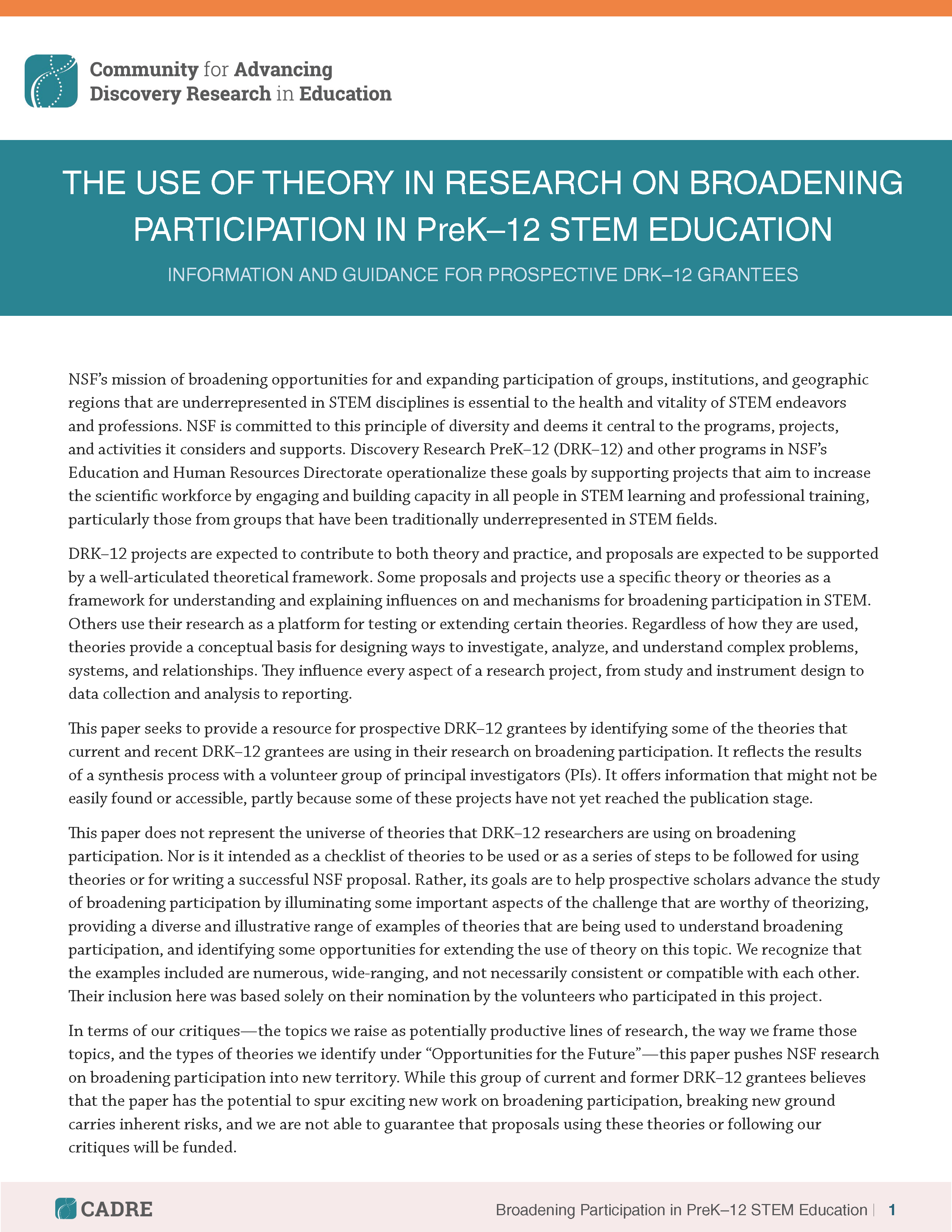
The Use of Theory in Research on Broadening Participation in PreK–12 STEM Education: Information and guidance for prospective DRK–12 grantees

This paper seeks to provide a resource for prospective DRK–12 grantees by identifying some of the theories that current and recent DRK–12 grantees are using in their research on broadening participation.

Author/Presenter

Arthur Powell

Natalie Nielsen

Malcolm Butler

Cory Buxton

Odis Johnson, Jr.

Leanne Ketterlin-Geller

Jennifer Stiles

Catherine McCulloch

Year
2018
Short Description

This paper seeks to provide a resource for prospective DRK-12 awardees by identifying some of the theories that current and recent DRK-12 awardees are using in their research on broadening participation.

Dissemination Toolkit: Policy Outreach

Policy icon

Why Communicate with Legislators and Their Staff?

Funding for the National Science Foundation (NSF) is contingent on legislative support. Because of this, it is important for NSF awardees to communicate with legislators about the value and importance of their projects. This is especially true for legislators who sit on committees relevant to STEM education.

Author/Presenter

CADRE

Year
2019
Short Description

Funding for the National Science Foundation (NSF) is contingent on legislative support. Because of this, it is important for NSF awardees to communicate with legislators about the value and importance of their projects.