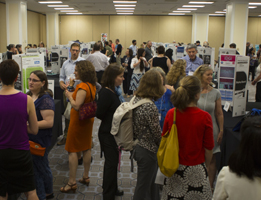
While family engagement in mathematics is highly predictive of children's mathematical outcomes, teachers' family engagement responsibilities are rarely addressed in teacher preparation programs. This conference seeks to improve how teacher preparation programs equip educators to engage families in preK-5 children's math learning by bringing together math teacher educators, preK-5 classroom teachers, families/caregivers, and mathematics teacher candidates. Beginning with an in-person gathering and followed by two virtual workshops, the conference will elevate models of community-engaged mathematics teacher preparation and explore the competencies that elementary grade teachers must develop to meaningfully engage families in mathematics.
Projects
To find a project on this archived website, we suggest searching the web for “site: cadrek12.org” along with keywords related to the item or topic of interest.
Sort By:
Start Date: Most Recent | Oldest
Alphabetical: A>Z | Z>A
09/15/2025
As STEM education researchers work to improve STEM teaching and learning in schools and districts across the nation, rural communities are often overlooked. There is a definite critical need for STEM education research focused on rural communities. Rural schools typically have less funding for STEM programs, have trouble recruiting and retaining quality STEM teachers, and have less access to STEM learning opportunities. Yet, rural communities possess an abundance of ingenuity, resourcefulness, and collective problem-solving skills. This project works to address this need by bringing together researchers, rural educators, and workforce leaders in rural communities to support the mutual exchange of knowledge and learning around pressing problems in rural K-12 STEM education, understanding rural ingenuity within teaching STEM, and STEM education's connection with the local workforce.
08/01/2025
This project will develop a sustainable Research-Practice Partnership (RPP) model between the Worcester Public Schools (WPS) and the Learning Sciences Lab at Worcester Polytechnic Institute (WPI). Together, WPI and WPS will build the collaborative infrastructure for conducting impactful STEM education research within WPS. Specifically, the RPP will establish and document shared infrastructural systematic processes and materials, brainstorm and facilitate research ideas that address pressing issues in mathematics education, and build a community of trust among researchers, administrators, teachers, and families to make future research and implementation, innovation, and collaboration more impactful, accessible, and efficient.
12/01/2024
Data science is fast becoming a dominant part of scientific, economic, and social scientific reasoning, as well as a necessary perspective for making life decisions that rely on data. But there is little work in either research or development with students younger than 2nd grade, and even less focusing on children not yet in kindergarten. By expanding knowledge in an emergent content area where young children are currently underserved, this set of three workshops will build capacity to create rigorous, equitable, inclusive, and culturally responsive data science teaching resources, a necessity for school readiness in the early childhood years.
09/01/2024
High-quality early educational experiences, particularly in mathematics, are crucial for students’ success in K-12 schooling. To create these foundational experiences for young children, early childhood educators need opportunities to enhance their mathematics teaching through job-embedded, sustained professional learning. This partnership development project establish a collaboration among early childhood mathematics educators, school and district leaders, the state department of education, and university faculty in Delaware that aims to enhance children’s early mathematics learning by collaboratively designing support systems for strengthening their teachers’ professional learning.
09/01/2024
Science education integrates the study of and practices from the Next Generation Science Standards (NGSS). At the fundamental level, the pedagogy involves teaching and learning that emphasizes the use of scientific inquiry and the engineering design process to develop students’ problem-solving, critical thinking, and collaboration skills. Unfortunately, funding and professional development for teachers, which is essential to assure successful implementation of science lessons to increase the potential for student achievement, is lacking.
Therefore, this NSF-funded science-education research project explored the development of a model that deepens the existing partnerships among grass-roots, non-profit community education organizations, K-12 public schools, and local university partners. Together, they worked collaboratively to develop a model where teachers could work together with community partners to implement high-quality, place-based, NGSS-aligned science learning opportunities that actively engage students in their classrooms during the school day.
This research project has led to the development of a full PreK-12 DRK proposal for high-quality professional development for teachers, using the newly developed Teacher-Plus-Community Partners (T+CP) model, with the goals of increasing science efficacy for teachers and impacting student achievement in science.
09/01/2024
This project will support a conference series, including an in-person gathering and virtual follow-up meetings, that will bring together teachers, researchers, education leaders, and instructional material designers to build a shared understanding of how to integrate the use of high-quality instructional materials with the benefits of localizing these materials to better address students’ contexts and backgrounds. By fostering dialogue, sharing models, and setting priorities for future research and design, the project seeks to build knowledge about inclusive, effective, and culturally responsive approaches to science instruction that will advance equitable science education in K–12 classrooms.
08/15/2024
Although science is increasingly recognized as a key dimension of early learning, findings to date indicate that young children, especially those enrolled in public preschool programs serving historically excluded communities, have limited opportunities to engage in high quality science investigations. The lack of professional learning resources available to teachers makes it challenging for them to feasibly and effectively promote science in their classrooms. To address this need, this four-year design and development project brings together public preschool teachers, families from culturally and linguistically diverse communities, early learning and STEM researchers, and designers of media to co-design a Professional Learning Hub for Early Science.
08/01/2024
Partnership development between universities and school districts requires an understanding that each organization has a distinct institutional point of view that must be considered in defining and shaping collaborative work. The goals and objectives of each organization may not always align, and at times may compete or conflict with each other. With the understanding that successful partnerships are those where practitioners and researchers achieve high levels of trust, commitment, transparency, interdependence, and mutual benefit, this project centers on building a partnership between a university that serves a largely Hispanic student population and a rural school district that also serves a community that has long been underrepresented in STEM education and career opportunities. The partners will jointly focus on how to respond to three negative impacts of the COVID-19 pandemic: 1) limited access to quality learning opportunities, 2) increased student learning gaps in STEM subjects, and 3) a local teacher shortage.
08/01/2024
Anxiety about math has increased for some students due to disruptions in their learning during the COVID-19 pandemic. This partnership development project involving Portland State University and the Tigard-Tualatin School District addresses pandemic-related learning challenges in middle school mathematics, with a focus on math anxiety. Across the yearlong project, the partners play equal roles in co-developing research, practice, and policy proposals aimed at enhancing math outcomes and reducing math anxiety among the district’s middle school students.
08/01/2024
Environmental issues like wildfires can serve as effective science learning contexts to promote scientific literacy and citizenship. This project will partner with teachers, teacher educators, and disciplinary experts in data science, fire ecology, public health, and environmental communication to co-design a data-driven, justice-oriented, and issue-based unit on wildfires. In the unit, student will engage in various data practices to gain insights into the issue of wildfires and how it affects their lives and communities. The project seeks to theorize how learners can leverage disciplinary knowledge and practices in environmental and data science as a foundation for making data-informed actions towards a more just and sustainable society.
08/01/2024
Tutoring programs that are jointly supported by schools and universities can offer benefits to both parties. The programs, however, are only helpful to the extent they respond to the needs and interests of the students and schools they serve. This project will establish a partnership between a large, urban university and a small, rural high school to collaboratively create a tutoring program to support the mathematics learning of students with learning disabilities.
07/15/2024
While more accessible online learning opportunities that reflect everyday teaching challenges are becoming more available, most of these more flexible professional development experiences are being offered by colleges and universities to teachers who are not yet in the classroom. This situation provides an opportunity to explore how innovations in teacher professional development can be woven into school districts’ regular professional development work with its teachers. This partnership development project will create a shared vision and plan for making digitally-based teaching tasks available to elementary math and science teachers so they can learn at any time and from anywhere.
04/01/2024
Science and engineering teaching and curriculum have begun to engage learners’ knowledge of themselves, their communities, and their experiences of science and engineering. This knowledge can make the experience of learning science and engineering more meaningful and impactful as learners can see greater connections between the content and how their own experiences and communities. However, assessment approaches for documenting and presenting what learners’ know have typically not been able to sufficiently represent the new approaches to teaching and learning. This conference brings together researchers, school leaders, and teachers to develop frameworks and resources for making culturally sustaining approaches to teaching and learning science and engineering.
02/15/2024
The Inter-university Consortium for Political and Social Research (ICPSR) will host a workshop that brings together NSF-funded teams working on midscale research infrastructure incubator projects for STEM education research with a focus on education equity. ICPSR will share information, resources, and support incubator teams in developing and managing mid-scale infrastructure projects. These incubator projects have identified research infrastructure gaps related to assessments, teacher practices, and digital tools to support student learning and have proposed pilot tools, cyberinfrastructure, large-scale datasets, etc., for filling these gaps. To scale these pilots, the teams will need to successfully develop proposals to create mid-scale research infrastructure (Midscale RI). However, Midscale RI proposals require specialized knowledge that is not common within the STEM education research community and thus may limit the community’s ability to develop competitive Midscale RI proposals.
09/01/2023
This project establishes a statewide teacher-researcher alliance of mathematics teachers and teacher leaders in Idaho, who will work with teacher educators at two universities with expertise in professional development and school-based research. The research focuses on two research-based strategies for improving students’ mathematics achievement. The first, Explicit Attention to Concepts, draws students’ attention specifically to the meaning of mathematical ideas while making connections between different ways to represent the content. The second, Students’ Opportunities to Struggle, helps students make sense of graspable new concepts through supported problem solving with peers, highlighting ways to overcome confusion, stimulate personal sense-making, build perseverance, and promote openness to challenge.
08/01/2023
This project brings together education researchers, high school science teachers, research scientists, and community-based organizations as co-design teams to modify science curriculum materials to be justice- and community-oriented. Building on existing partnerships between education researchers and 11 science teachers in two districts in Illinois, project teams will engage in cycles of curriculum analysis and adaptation over the course of 3 years. These professional learning cycles will develop pedagogically relevant content expertise, such as deepened understanding of locally relevant science phenomena, as well as infrastructure for community-engaged science instruction.
07/15/2023
Today’s schools are experiencing increasing cultural and linguistic diversity and facing the challenge of creating meaningful connections between school science and student lived experiences outside of school. Middle school is a critical time to provide fundamental knowledge and encourage interest in STEM careers. In order to best impact learners during this critical period, science teachers need improved models to support the development and delivery of relevant curriculum materials to better serve all students in their classrooms. Highly supported design teams consisting of researchers, teachers, and both school and district science specialists will co-adapt existing district-generated science units to integrate socially and culturally relevant science practices and draw on students' diverse cultural and language practices as strengths.
08/01/2022
This project aims to elaborate a structure for practice-oriented, collaborative professional development that increases the capacities for collaborative learning by facilitating teacher-to-teacher interactions within and across cultural contexts. By convening international groups of teachers to design lessons and provide and respond to commentaries on their lesson designs, the project introduces possibilities for surfacing and disrupting common experiences, assumptions, and norms in US mathematics teaching.
09/01/2021
This project focuses on supporting emerging scholars who have new ideas and approaches for approaching racial equity in their scholarship and work. The workshop, implemented as a series of sessions over the course of a year, will support early career scholars in STEM education and the learning sciences in preparing proposals to submit to the National Science Foundation.
08/15/2021
This project will investigate the challenges, needs, and support for Historically Black Colleges and Universities (HBCUs) to succeed in applying for educational research support from the National Science Foundation (NSF), in particular the Division of Research on Learning in Informal and Formal Settings (DRL). The project will investigate what changes and/or supports would contribute to significantly increasing the number of applications and successful grant awards for STEM educational research project proposed by HBCUs.
08/01/2021
The Framework for K-12 Science Education has set forth an ambitious vision for science learning by integrating disciplinary science ideas, scientific and engineering practices, and crosscutting concepts, so that students could develop competence to meet the STEM challenges of the 21st century. Achieving this vision requires transformation of assessment practices from relying on multiple-choice items to performance-based knowledge-in-use tasks. However, these performance-based constructed-response items often prohibit timely feedback, which, in turn, has hindered science teachers from using these assessments. Artificial Intelligence (AI) has demonstrated great potential to meet this assessment challenge. To tackle this challenge, experts in assessment, AI, and science education will gather for a two-day conference at University of Georgia to generate knowledge of integrating AI in science assessment.
07/15/2021
This project will develop a process for creating a shared, state-wide vision of high-quality mathematics instruction. It will also develop and study the resources to implement that vision at the state, district, and school levels. In addition, the project will investigate a collaborative process of designing and implementing high-quality mathematics instruction at a state level.
07/01/2021
Understanding the impact of STEM education efforts requires researchers to have cutting-edge knowledge of advanced research methods and the ability to translate research knowledge to multiple and diverse stakeholder audiences. The Evidence Quality and Reach (EQR) Hub project will work explicitly to strengthen these two competencies through focused work with the Discovery Research PreK-12 research community. The hub will develop and implement workshops and learning opportunities for researchers in the community, convene communities of practice to discuss specific research methods, and engage in individualized consultations with DRK-12 projects.
11/01/2020
This project will design and study an innovative model of collaborative learning for pre-service and experienced elementary, middle, and secondary mathematics teachers that focuses on equitable mathematics teaching practices that include understanding students' knowledge, math understandings, and experiences they bring to the classroom.