
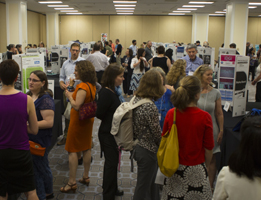
While family engagement in mathematics is highly predictive of children's mathematical outcomes, teachers' family engagement responsibilities are rarely addressed in teacher preparation programs. This conference seeks to improve how teacher preparation programs equip educators to engage families in preK-5 children's math learning by bringing together math teacher educators, preK-5 classroom teachers, families/caregivers, and mathematics teacher candidates. Beginning with an in-person gathering and followed by two virtual workshops, the conference will elevate models of community-engaged mathematics teacher preparation and explore the competencies that elementary grade teachers must develop to meaningfully engage families in mathematics.
Projects
To find a project on this archived website, we suggest searching the web for “site: cadrek12.org” along with keywords related to the item or topic of interest.
Sort By:
Start Date: Most Recent | Oldest
Alphabetical: A>Z | Z>A
08/01/2025
Scientific argumentation is one of the eight essential practices in the Next Generation Science Standards. Over the past decade, various methods have been employed to help middle-school students develop argumentation skills in formal learning environments. Despite these efforts, teachers continue to face challenges in motivating and engaging students, particularly in addressing the increasingly varied needs of students. Additionally, districts and schools struggle to integrate these research-based methods into their curriculum in ways that gain buy-in from teachers, students, and stakeholders. To address these challenges, this partnership development project brings together the West Aurora School District in Illinois and Northern Illinois University to pursue two primary goals: (1) co-construct a research and development plan focusing on ways to enhance support and effectiveness in the teaching practice of scientific argumentation through technology, and (2) develop a model for building a design research partnership between a school district and a mid-size public university.
09/15/2024
Society has grown to rely on smart, embedded, and interconnected systems. This has created a great need for well-qualified and motivated engineers, scientists, and technicians who can design, develop, and deploy innovative microelectronics and Artificial Intelligence (AI) technologies, which drive these systems. This project will address the need for a more robust computer science and engineering workforce by broadening access to microelectronics and AI education leveraging the cutting-edge technologies of Tiny Machine Learning and low-cost microcontroller systems in diverse high schools. The goal of this project is to engage high-school students and teachers from underresourced communities in the design and creative application of AI-enabled smart, embedded technologies, while supporting their engineering identity development and preparing them for the STEM jobs of tomorrow.
09/15/2024
Society has grown to rely on smart, embedded, and interconnected systems. This has created a great need for well-qualified and motivated engineers, scientists, and technicians who can design, develop, and deploy innovative microelectronics and Artificial Intelligence (AI) technologies, which drive these systems. This project will address the need for a more robust computer science and engineering workforce by broadening access to microelectronics and AI education leveraging the cutting-edge technologies of Tiny Machine Learning and low-cost microcontroller systems in diverse high schools. The goal of this project is to engage high-school students and teachers from underresourced communities in the design and creative application of AI-enabled smart, embedded technologies, while supporting their engineering identity development and preparing them for the STEM jobs of tomorrow.
09/15/2024
Society has grown to rely on smart, embedded, and interconnected systems. This has created a great need for well-qualified and motivated engineers, scientists, and technicians who can design, develop, and deploy innovative microelectronics and Artificial Intelligence (AI) technologies, which drive these systems. This project will address the need for a more robust computer science and engineering workforce by broadening access to microelectronics and AI education leveraging the cutting-edge technologies of Tiny Machine Learning and low-cost microcontroller systems in diverse high schools. The goal of this project is to engage high-school students and teachers from underresourced communities in the design and creative application of AI-enabled smart, embedded technologies, while supporting their engineering identity development and preparing them for the STEM jobs of tomorrow.
08/15/2024
Although science is increasingly recognized as a key dimension of early learning, findings to date indicate that young children, especially those enrolled in public preschool programs serving historically excluded communities, have limited opportunities to engage in high quality science investigations. The lack of professional learning resources available to teachers makes it challenging for them to feasibly and effectively promote science in their classrooms. To address this need, this four-year design and development project brings together public preschool teachers, families from culturally and linguistically diverse communities, early learning and STEM researchers, and designers of media to co-design a Professional Learning Hub for Early Science.
08/15/2024
Young children thrive when strong relationships exist between their home and school environments. Early home and school experiences support the development of mathematical skills. Often, schools and teachers struggle to establish these strong relationships; therefore, Math Partners will work with teachers and teaching assistants in classroom design teams to help teachers establish healthy, positive relationships with families that center families’ knowledge and experiences in the context of mathematics.
08/15/2024
Despite years of research and interventions to address inequities that are largely related to race, science education continues to perpetuate these inequities in both participation and outcomes in science. This CAREER project will address the need to provide science teachers with a framework for considering race and racial dynamics in science teaching as well as exemplars in science teaching and professional development to support teachers’ teaching identities and praxis.
08/01/2024
Although there is a push to integrate artificial intelligence (AI) in K-12 education, the novelty of AI means that little is known about what schools, teachers, students, and parents know, need, and expect regarding AI in classrooms. The lack of access to AI knowledge and training is especially significant in rural high-needs communities where schools are under-resourced. This year-long partnership development project will seek to strengthen and expand existing research-practice partnerships (RPPs) with East Tennessee teachers and school leaders, develop new RPPs with parents and students enrolled in East Tennessee middle and high schools, and co-construct a shared vision for AI that aligns with the needs and assets of the partner community.
06/01/2024
This five-year participatory research project follows students from transitional kindergarten to third grade to understand whether and how Number Talks (i.e., ten-to-fifteen-minute math discussions where students mentally solve mathematics problems and then come together as a class to share their mathematical reasoning) can empower students to develop productive mathematical identities while strengthening their number sense. As part of this work, grade level teams of teachers will investigate how to leverage the knowledge, skills, and resources students bring with them to mathematics class in order to spark productive mathematical identity development.
10/01/2023
The purpose of this project is to develop a home mathematics environment (HME) intervention for preschool-aged children with developmental delays (DD). The project includes caregivers of children with DD as collaborators in the iterative design process to develop feasible and sustainable HME intervention activities.
09/15/2023
This RAPID project responds to the Buffalo blizzard of 2022 (Buffalo, NY) by developing, with and for the community, a science education curriculum framework focused on disaster justice and resilience. This project will document the science education human and social impact of the blizzard by capturing the experiences, reflections, and needs of science teachers, Black and Brown community leaders, and families who were directly affected.
08/01/2023
This synthesis study includes a comprehensive systematic review and meta-analysis of research published since 2001 evaluating the impact of family engagement interventions on student STEM outcomes. The goal of this project is to (a) determine the effectiveness of family engagement interventions on STEM outcomes, (b) identify practices/components within interventions that are most effective for promoting STEM outcomes, and (c) reveal the extent to which the effects of family engagement interventions vary as a function of study quality and/or certain child, family, and community characteristics.
08/01/2023
This project aims to create and test an innovative educational approach for bringing STEM learning experiences to underserved youth. It will co-create and study an outdoor robotic-augmented playground called the “Smart Playground” and a corresponding series of classroom lessons. The Smart Playground will be co-designed with Latinx families and educators to engage children in developing computational thinking skills and learning about robotics in a physical environment using a culturally sustaining approach. Research and evaluation will examine whether exposure to the Smart Playground and corresponding classroom activities have an impact on the development of computational thinking in young children.
08/01/2023
This project aims to create and test an innovative educational approach for bringing STEM learning experiences to underserved youth. It will co-create and study an outdoor robotic-augmented playground called the “Smart Playground” and a corresponding series of classroom lessons. The Smart Playground will be co-designed with Latinx families and educators to engage children in developing computational thinking skills and learning about robotics in a physical environment using a culturally sustaining approach. Research and evaluation will examine whether exposure to the Smart Playground and corresponding classroom activities have an impact on the development of computational thinking in young children.
08/01/2023
This project aims to create and test an innovative educational approach for bringing STEM learning experiences to underserved youth. It will co-create and study an outdoor robotic-augmented playground called the “Smart Playground” and a corresponding series of classroom lessons. The Smart Playground will be co-designed with Latinx families and educators to engage children in developing computational thinking skills and learning about robotics in a physical environment using a culturally sustaining approach. Research and evaluation will examine whether exposure to the Smart Playground and corresponding classroom activities have an impact on the development of computational thinking in young children.
06/15/2023
Acquiring scientific knowledge and skills requires persisting through challenges, yet it has become increasingly common for parents in the United States to step in and solve problems for their children. This type of over-engaged parenting leads preschool-age children to have lower persistence, lower executive function, and worse reading and math achievement in grade school across socioeconomic backgrounds. Prior work leaves open major theoretical and practical questions about the beliefs that drive over-engaged parenting and children’s response to it. Our research aims to fill these gaps by examining the causes and consequences of over-engaged parenting so that we can better understand how caregivers can support children's scientific success upon school entry.
09/01/2022
Familial presence in school supports children’s learning. However, few models exist that illustrate forms of familial presence in STEM learning that center familial cultural knowledge and practice. The project will produce a model for familial engagement in STEM along with instructional tools and illustrative case-studies that can be used by teachers and school districts nationally in support of increasing students’ STEM learning. This three-year study investigates new instructional practices that support rightful familial presence in STEM as a mechanism to address the continued racial and class gaps in STEM achievement for historically marginalized students.
08/15/2022
This project focuses on developing anti-racist mathematics teaching and learning practices that have led to inequitable school experiences for Black, Indigenous, and Latinx students. This study is a partnership with school and central office leaders from one district and educational researchers from three universities with expertise in both educational leadership and mathematics education. Partnership activities include documenting how leaders learn and develop anti-racist leadership practices and then measuring the impact on teachers’ instruction and students’ experiences.
07/01/2022
This project aims to meet this need by developing PreK-5, equity-oriented, field-based, interdisciplinary curricular materials that support students' socioecological reasoning and sustainable decision making. The science learning experiences will be integrated across disciplines from literacy to civic and social studies lessons. The curricular materials will be part of a science education model that facilitates family engagement in ways that transform relations between educators, families, and students' science learning. The curricular activities will be co-designed with teachers while using local nature and culture as a resource.
07/01/2022
This project aims to meet this need by developing PreK-5, equity-oriented, field-based, interdisciplinary curricular materials that support students' socioecological reasoning and sustainable decision making. The science learning experiences will be integrated across disciplines from literacy to civic and social studies lessons. The curricular materials will be part of a science education model that facilitates family engagement in ways that transform relations between educators, families, and students' science learning. The curricular activities will be co-designed with teachers while using local nature and culture as a resource.
05/15/2022
This project seeks to investigate the possibilities and challenges of using a participatory approach to research and design, centering Black, Indigenous, Latinx, and Hmong students and their families in imagining and creating change. The project will generate new knowledge about the possibilities and limitations of participatory design research (PDR) as a method for advancing equity in mathematics education through PDR cycles at three middle schools over the five years of the project. This approach has the potential to disrupt inequitable practices of mathematics education as well as undemocratic processes for making decisions about mathematics education. Further, it will be a catalyst for developing racially just practices and processes in mathematics education.
03/15/2022
Building on the team's prior research from early in the pandemic, this project team will continue to collect data from families and aims to understand parents’ perspectives on the educational impacts of COVID-19 by leveraging a nationally representative, longitudinal study, the Understanding America Study (UAS). The study will track educational experiences during the spring and summer of 2022 and into the 2022-23 school year. The team will analyze student and family overall and for key demographic groups of interest as schooling during the pandemic continues. This RAPID project allows critically important data to continue to be collected and contribute to continued understanding of the impacts of and responses to the pandemic by American families.
10/01/2021
This project addresses a longstanding problem in informal science education: how to increase the likelihood of consequential STEM learning from short duration experiences such as field trips. The project seeks to harness the power and potential of visual representations (e.g., graphs, drawings, charts, maps, etc.) for enhancing learning and encouraging effective reflection during and after science learning experiences, and provide new and actionable informal science learning practices that promote engagement with visual representations and reflection, and science understandings that can be applied broadly by informal science institutions.
10/01/2021
This project addresses a longstanding problem in informal science education: how to increase the likelihood of consequential STEM learning from short duration experiences such as field trips. The project seeks to harness the power and potential of visual representations (e.g., graphs, drawings, charts, maps, etc.) for enhancing learning and encouraging effective reflection during and after science learning experiences, and provide new and actionable informal science learning practices that promote engagement with visual representations and reflection, and science understandings that can be applied broadly by informal science institutions.