
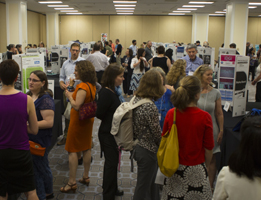
The Inter-university Consortium for Political and Social Research (ICPSR) will host a workshop that brings together NSF-funded teams working on midscale research infrastructure incubator projects for STEM education research with a focus on education equity. ICPSR will share information, resources, and support incubator teams in developing and managing mid-scale infrastructure projects. These incubator projects have identified research infrastructure gaps related to assessments, teacher practices, and digital tools to support student learning and have proposed pilot tools, cyberinfrastructure, large-scale datasets, etc., for filling these gaps. To scale these pilots, the teams will need to successfully develop proposals to create mid-scale research infrastructure (Midscale RI). However, Midscale RI proposals require specialized knowledge that is not common within the STEM education research community and thus may limit the community’s ability to develop competitive Midscale RI proposals.
Projects
To find a project on this archived website, we suggest searching the web for “site: cadrek12.org” along with keywords related to the item or topic of interest.
Sort By:
Start Date: Most Recent | Oldest
Alphabetical: A>Z | Z>A
One crucial predictor of success in STEM disciplines is spatial reasoning ability, which involves mentally manipulating and representing objects in space. However, STEM courses often neglect the purposeful development of spatial reasoning skills, and limited knowledge exists on effective training methods. This project aims to address this gap by: 1) identifying neural and cognitive processes associated with successful mental rotation, a fundamental aspect of spatial reasoning; 2) assessing the responsiveness of these processes to training; and 3) measuring the transfer of training effects to real-world STEM problems, specifically focusing on introductory chemistry.
Through this project, the North Carolina State University Data Science Academy will identify the key success components of a model for the recruitment and mentoring of a diverse cohort of postdoctoral fellows who will enter their professions with expertise in data science education research. This model is intended to train and support scholars who have differing levels of experience and strengths in STEM, STEM education, education research, or data science.
This project considers how teachers’ engagement in scientific sensemaking as an opportunity for teachers’ learning to support more expansive science learning environments. It seeks to address two ongoing challenges in science teacher education: the need for teachers to learn (1) to recognize, value, and integrate students’ diverse ways of knowing, communicating, and relating with one another and phenomena and (2) to acknowledge and disrupt restrictive narratives that shape what counts as science in schools and who is seen as a scientist. This project will provide new models for science teacher education to engage teachers in expansive scientific sensemaking, seeking to develop more humanizing relationships between teachers, students, and science. More broadly, the project will produce a new structure for professional learning and resources for supporting more heterogeneous and equitable forms of science in teacher education.
Teachers’ beliefs influence their instructional decisions and these decisions shape the mathematical learning opportunities for all students. This is particularly important when considering the learning opportunities for groups that have historically been marginalized in mathematics, including girls and students of color. There are few validated, mathematics-specific instruments that measure teachers’ beliefs about mathematics learning related to race, ethnicity, and gender. This project seeks to investigate teachers’ beliefs related to how they explain the systemic racial and gender differences in mathematics education outcomes by developing and validating a survey instrument and to explore how those beliefs might impact their teaching.
This project focuses on supporting emerging scholars who have new ideas and approaches for approaching racial equity in their scholarship and work. The workshop, implemented as a series of sessions over the course of a year, will support early career scholars in STEM education and the learning sciences in preparing proposals to submit to the National Science Foundation.
This project will investigate the challenges, needs, and support for Historically Black Colleges and Universities (HBCUs) to succeed in applying for educational research support from the National Science Foundation (NSF), in particular the Division of Research on Learning in Informal and Formal Settings (DRL). The project will investigate what changes and/or supports would contribute to significantly increasing the number of applications and successful grant awards for STEM educational research project proposed by HBCUs.
Using high school statewide longitudinal data from Maryland from 2012-2022, this study will first document who has taught STEM-CTE courses over this period. After exploring the teaching landscape, the study will then explore whether qualifications (i.e., education, credentials, teaching experience) of teachers in STEM-CTE high school courses were associated with their students’ success.
Understanding the impact of STEM education efforts requires researchers to have cutting-edge knowledge of advanced research methods and the ability to translate research knowledge to multiple and diverse stakeholder audiences. The Evidence Quality and Reach (EQR) Hub project will work explicitly to strengthen these two competencies through focused work with the Discovery Research PreK-12 research community. The hub will develop and implement workshops and learning opportunities for researchers in the community, convene communities of practice to discuss specific research methods, and engage in individualized consultations with DRK-12 projects.
This project will synthesize research on computer-supported collaborative learning (CSCL). The science of CSCL achieved advances in the past decade, including producing a research handbook—however, practitioners do not have easy access to research journals, nor time to sift through the latest findings to guide their practice. Further, conventional forms of research synthesis, such as research handbooks or long synthesis papers, serve narrow audiences and are rarely read by practitioners. The research team will investigate and develop a novel synthesis approach to provide educators and researchers with a novel form of synthesis organized around an interactive map of topics and subtopics.
The goal of this planning grant is to explicitly focus on broadening participation in the K-12 STEM teaching workforce, with the theory of action that diversifying the K-12 STEM teaching workforce would in the long term help more students see STEM as accessible to them and then be more likely to choose a STEM degree or career.
The goal of this project is to develop learning progressions and assessment items targeting computational thinking. The items will be used for a test of college-ready critical reasoning skills and will be integrated into an existing online assessment system, the Berkeley Assessment System Software.
The goal of this project is to develop learning progressions and assessment items targeting computational thinking. The items will be used for a test of college-ready critical reasoning skills and will be integrated into an existing online assessment system, the Berkeley Assessment System Software.
This project addresses the pressing need to more effectively organize STEM (science, technology, engineering, and mathematics) teaching and learning around "big ideas" that run through science disciplines. Unfortunately, finding ways to teach big ideas effectively so they become useful as knowledge frameworks is a significant challenge. Deep structure modeling (DSM), the innovation advanced in this project, is designed to meet this challenge in the context of high school biology.
This project will study the effect of integrating computing into preservice teacher programs. The project will use design-based research to explore how to connect computing concepts and integration activities to teachers' subject area knowledge and teaching practice, and which computing concepts are most valuable for general computational literacy.
The COVID-19 pandemic has significantly disrupted the ability of teacher education programs to place their teacher candidates in typical K-12 teaching settings as a part of learning to teach. This project examines how simulated classroom field experiences for preservice teachers can be implemented in online and emergency remote teacher education courses.
In this project, over 500 elementary education majors will team with engineering majors to teach engineering design to over 1,600 students from underrepresented groups. These standards-based lessons will emphasize student questioning, constructive student-to-student interactions, and engineering design processes, and they will be tailored to build from students' interests and strengths.
The focus of this conference is to carefully examine past and current research with an eye toward improving its impact on practice and to create concrete steps that could shape the nature and impact of mathematics education research.
This project will address the potential positive and negative impacts of using 360-degree video for bridging the gap between theory and practice in mathematics instruction by investigating how preservice teachers' tacit and explicit professional knowledge are facilitated using immersive video technology and annotations.
This project will support the participation of 53 US K-12 mathematics teachers, graduate students, community college/university mathematicians, mathematics teacher educators, and mathematics education researchers to attend the Fourteenth International Congress for Mathematical Education (ICME-14) in Shanghai, China.
The primary goal of this set of workshops is to provide STEM education researchers with the framework, skills, and community they need to implement new developments in causal inference methods into their research.
The purpose of this project is to fully explore the mathematics education literature to synthesize what validity evidence is available for quantitative assessments in mathematics education.
The purpose of this project is to fully explore the mathematics education literature to synthesize what validity evidence is available for quantitative assessments in mathematics education.
The Third National Conference on Doctoral Programs in Mathematics Education will bring together a group of faculty members in mathematics education from a range of institutions that currently graduate doctorates in mathematics education.
This purpose of this project is to develop and validate a range of assessments with a focus on academic preparedness for higher education. The team will explore relevant qualities of assessments such as their differential predictive validity to ensure they are appropriate for underrepresented groups, the optimal grade level to begin assessing readiness, and measures that are most appropriate for predicting STEM-specific readiness.