
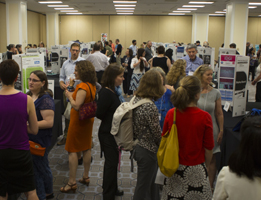
This project will capitalize on the STEM for All Video Showcase and extend its impact by creating a STEM for All Multiplex. The Multiplex will draw on past and future Video Showcase videos to create a multimedia environment for professional and public exchange, as well as to provide a way for anyone to search the growing database of videos, create thematic playlists, and re-use the content in new educational and research contexts.
Projects
To find a project on this archived website, we suggest searching the web for “site: cadrek12.org” along with keywords related to the item or topic of interest.
Sort By:
Start Date: Most Recent | Oldest
Alphabetical: A>Z | Z>A
09/01/2019
This project will use an alternative model for online videos to develop video units that feature the unscripted dialogue of pairs of students. The project team will create a repository of 6 dialogic mathematics video units that target important Algebra 1 and 2 topics for high school and upper middle school students, though the approach can be applied to any STEM topic, for any age level.
09/15/2016
This project will explore the potential of video-based formative feedback to enhance professional development around ambitious instruction for secondary teachers in urban schools.
09/01/2016
This project will develop and implement an innovative online mathematics professional development model designed to provide growth opportunities for teachers in rural districts who normally lack access to such opportunities. The project will focus on developing teacher capacity to enact ambitious, responsive instruction aligned with the Common Core State Standards for Mathematics (CCSSM), and thus will be sustained, interactive, and of sufficient duration to help teachers transform their practices.
08/01/2015
This project will use video case studies to identify key strategies used by exemplary teachers to guide class discussions. The project will study teachers in the areas of high school mechanics and electricity, and middle school life sciences, and is designed to develop the constructs and language that will enable us to describe key discussion leading strategies for fostering scientific modeling and thinking skills, as well as conceptual understandings. The project will build on the results of classroom case studies as well as findings from studies of thinking processes in scientists. It will develop an integrated theoretical framework for model based learning and teaching in science.
09/01/2014
This project will develop a video recording and analysis system called VideoReView (VRV) that allows grade four science teachers to record, tag, and analyze video in their classroom in real time. The investigators will then study and enhance the system in the context of professional learning communities of teachers.
09/01/2014
Despite the tremendous growth in the availability of mathematics videos online, little research has investigated student learning from them. The goal of this exploratory project is to create, investigate, and provide evidence of promise for a model of online videos that embodies a more expansive vision of both the nature of the content and the pedagogical approach than is currently represented in YouTube-style lessons.
08/15/2014
The goal of this CAREER program of research is to identify, from a cross-cultural perspective, essential Algebraic Knowledge for Teaching (AKT) that will enable elementary teachers to better develop students' algebraic thinking. This study explores AKT based on integrated insights of the U.S. and Chinese expert teachers' classroom performance.
05/15/2014
Most students learn about negative numbers long after they have learned about positive numbers, and they have little time or opportunity to build on their prior understanding by contrasting the two concepts. The purpose of this CAREER project is to identify language factors and instructional sequences that contribute to improving elementary students' understanding of addition and subtraction problems involving negative integers.
10/01/2013
This project addresses the need for a curricular resource package to support a high school biology course fully aligned to the core ideas, crosscutting concepts, and scientific practices of College and Career Readiness standards. The project will develop a suite of resources including educative curricular materials, pedagogical tools, intensive teacher professional development, and video documentation of exemplary implementation and investigate the impact of the instructional resource on teacher and student learning.
09/15/2013
This project is developing, iteratively refining and evaluating a science curriculum for Pre-K classrooms with units on Plant Growth, How Things Move, and What Makes Shadows by integrating traditional classroom resources (large and small group activities, hands-on activities, read-alouds) with digital media (touch screen tablets, photos and short videos, and games/simulations).
09/15/2013
This project investigates stereotype threat at the classroom level and in the context of inquiry-based instruction, in order to develop strategies and a related professional development course, using the principles of Universal Design for Learning, to help teachers learn how to mitigate stereotype threat.
10/01/2012
Concord Consortium is exploring K-2 students' understanding of heat and temperature in two Massachusetts school districts using sensors that display temperatures as colors. Exploration activities are being created, and students are being videotaped carrying out the activities. Students complete a short assessment for each activity. The exploration activities, assessments, and project data are available via open source through a website at Concord Consortium and are being presented to multiple professional audiences.
08/15/2011
This project engages high-school students as student-tutors who create screen-capture videos that demonstrate step-by-step solutions to mathematical problems and explicate the use of interactive applets. The project tests whether the mathematical and communication skills of student-tutors improve in the process of making the video materials. It also tests whether teachers and student users benefit from the videos. The project will examine whether the process of creating and disseminating the videos is replicable and scalable.
08/01/2011
This is a four-year project that is producing materials designed to help teachers see how the mathematical practices described in the Common Core State Standards for mathematics can be implemented in mathematics instruction. The goal of the improved instruction is to help students adopt and value these critical mathematical practices.
09/01/2010
This project investigated the professional development needed to make teachers comfortable teaching with multi-user simulations and communications that students use every day. The enactment with OpenSim (an open source, modular, expandable platform used to create simulated 3D spaces with customizable terrain, weather and physics) also provides an opportunity to demonstrate the level of planning and preparation that go into fashioning modules with all selected cyber-enabled cognitive tools framed by constructivism, such as GoogleEarth and Biologica.
09/01/2010
This project will develop and systematically investigate a teaching model to assist teachers in developing ideas about proof in grades 2-5. The teaching model provides both a tool for learning on the part of elementary teachers and a model of practice from which they can learn as they implement it.
09/01/2010
This project is creating and studying a professional development model to support preK teachers in developing culturally and developmentally appropriate practices in counting and early number. The proposed model is targeted at teachers of children in four-year-old kindergarten, and focuses on culturally relevant teaching and learning. The model stresses counting and basic number operations with the intention of exploring the domain as it connects to children's experiences in their homes and communities.
07/15/2010
This project will design, develop, and test a virtual learning community (VLC) to enhance the ability of first- and fourth-grade teachers to provide mathematics education. The goal is to produce a prototype of a VLC for first- and fourth-grade Everyday Mathematics teachers that integrates three primary elements: (a) learning objects rooted in practice, such as lesson video, (b) community-building tools offered by the internet, and (c) focused content that drives teachers' professional learning in mathematics.
03/15/2010
The aim of this project is to explore the hypothesis that a curricular focus on quantitative reasoning in middle grades mathematics can enhance development of student skill and understanding about mathematical proof. The project is addressing that hypothesis through a series of studies that include small group teaching experiments with students, professional development work with teachers, and classroom field tests of curricular units that connect quantitative reasoning and proof in algebra.
09/15/2009
This project is developing and testing a prototype electronic teacher's guide for a 12-week genetics unit in the NSF-funded curriculum titled Foundation Science: Biology to determine how it impacts high school teachers' learning and practice. The electronic guide, which is based on an existing print guide, has a flexible design so that it anticipates and meets the curriculum planning and support needs of teachers with different knowledge/skills profiles.
09/15/2009
This project is developing a two-year, intensive professional development model to build middle-grades mathematics teachers’ knowledge and implementation of formative assessment. Using a combination of institutes, classroom practice, and ongoing support through professional learning communities and web-based resources, this model helps teachers internalize and integrate a comprehensive understanding of formative assessment into daily practice.
09/01/2009
This project operationalizes research in number, operation, and early algebra. It builds on the paradigm of Dynamic Geometry (the interactive and continuous manipulation of geometric shapes and constructions) with a new technological paradigm, Dynamic Number, centered on the direct manipulation of numerical representations and constructions. Using The Geometer’s Sketchpad as a starting point, KCP Technologies is developing new software tools to deepen students’ conceptions of number and early algebra in grades 2–8.
09/01/2009
We developed and tested two ecology case study units for urban high school students underserved in their connection to nature. The case studies, based on digital media stories about current science produced by the American Museum of Natural History, use current scientific data to link ecological principles to daily life and environmental issues. Preliminary testing results show that treatment students made significantly higher gains than the control students on the project's major learning goals.
09/01/2009
This project hypothesizes that learners must have access to the real work of scientists if they are to learn both about the nature of science and to do inquiry themselves. It explores the question "How can informal science education institutions best design resources to support teachers, school administrators, and families in the teaching and learning of students to conduct scientific investigations and better understand the nature of science?"